
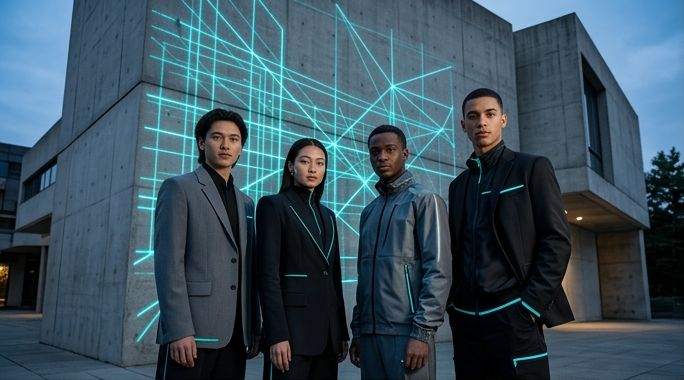
How shared practice, open culture, and real connection shape projection art.
Video mapping has grown from a niche technical curiosity into a global creative language – and its most lasting achievements have rarely been solo acts. Behind every spectacular projection is a web of collaboration, mentorship, shared code, and community trust.
Video mapping – projecting imagery onto three-dimensional surfaces so that light conforms precisely to physical contours – has moved from theater set experiments into public art, brand spectacle, and interactive performance. Festivals draw hundreds of thousands of visitors; universities offer accredited courses; corporations spend millions on projection-mapped activations. But the discipline can isolate its practitioners. Equipment costs are steep, the technical domains are many, and the gap between a promising idea and a finished installation is rarely bridged without shared expertise and trust. You don’t build that alone.
The Value of Community
The economics shift when costs are shared. Equipment libraries, group purchasing deals, and rental pools have let collectives from Berlin to Bogotá produce work that no single member could afford. Knowledge sharing cuts the learning curve: a forum thread from someone who’s already hit a GPU bottleneck in Resolume Arena is worth more to a newcomer than hours of documentation. Collective creativity also produces different results – not just faster ones. teamLab built its global reputation on exactly this, assembling teams of engineers, mathematicians, and artists who develop code, narrative, and spatial design together rather than in sequence. And community creates visibility: co-crediting a celebrated installation opens professional doors that a solo portfolio rarely does.
Networking Strategies
Local meetups remain powerful because they create the kind of sustained, informal conversation that online platforms can’t replicate. Projection Mapping meetup groups have run hands-on sessions worldwide where participants bring their own hardware, troubleshoot together, and experiment without the pressure of a professional context. Online, the TouchDesigner forum has become one of the most substantive technical communities in creative technology – threads regularly include developers responding alongside senior practitioners and students. Reddit’s r/projection_mapping is a lower-stakes entry point, while Discord servers run by regional VJ collectives add real-time file sharing that forums can’t match.
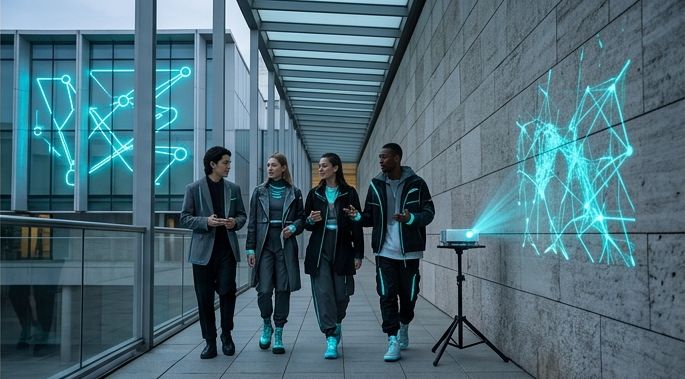
Collaborative projects create accountability that turns acquaintances into genuine partners. The Signal Festival in Prague pairs accepted artists with local technical mentors during production – several co-founders of subsequent studios first met through that process. Mentorship matters because talent alone doesn’t get you far without connections. The French collective 1024 Architecture has made knowledge transfer part of its identity, hosting junior artists for extended collaborative residencies.
Case Study – Mapping Festival, Geneva
Founded in 2005, the Mapping Festival was one of the first to combine public projection events with symposia and workshops in a single program. Treating professional development and public exhibition as inseparable, it built one of the earliest substantial international networks of projection artists and VJs – relationships that have held across decades.
Collaboration Models
Open-source sharing runs through the most innovative corners of the community. HC Gilje maintained VPT (Video Projection Tool) as a free application for years specifically to lower barriers where commercial software costs are out of reach. Co-production lets collectives take on a scale no single studio could manage – when architectural mapping requires simultaneous control of projection hardware, real-time rendering, and structural rigging across hundreds of meters of facade, pooled resources are the only way it happens. Stereolux in Nantes runs as a laboratory where resident artists get access to professional equipment and curatorial guidance over weeks or months, doing the kind of cross-disciplinary work that commercial commissions rarely allow. Joanie Lemercier’s collaborations with architects and environmental scientists show what happens when video mapping enters genuine dialogue with a different discipline: both partners end up somewhere neither could have reached alone.
Case Study – teamLab Borderless
teamLab Borderless, which opened in Tokyo in 2018 and reopened in 2024, is the clearest example of what sustained cross-disciplinary collaboration looks like at institutional scale. A permanent in-house team of engineers, programmers, and artists working in continuous dialogue has built immersive environments whose complexity would be impossible under any conventional studio-contractor structure. However, even innovative communities face significant challenges, from funding to inclusion.
Overcoming Challenges
Artistic freedom and technical standards pull in opposite directions. Residency programs and low-stakes events can absorb experimentation; public commissions need tighter specifications. Intellectual property in collaborative work has no clean answer, but communities that put written agreements in place before disputes arise tend to come through conflicts with their relationships intact. Creative Commons has been widely adopted for exactly this reason. Diversity doesn’t happen through openness alone – it requires deliberate choices about who gets invited, funded, and platformed. ARTECHOUSE in Washington D.C. has been one of the clearer examples among immersive art venues. Funding remains the hardest problem; getting past the credibility gap usually means partnering early with established institutions willing to serve as fiscal sponsors while a new community finds its footing.
Case Studies and Best Practices
iMapp Bucharest, projected onto the facade of the Palace of Parliament, has developed one of the most transparent competition formats in the discipline. It publishes detailed technical specifications for its facade and provides equipment and on-site support to all finalists, reflecting a philosophy that the competition exists to develop the global community, not merely to showcase existing talent. The Fête des Lumières in Lyon draws over two million visitors each December and commissions both established studios like AntiVJ and first-time public artists, thanks to the festival’s stable city funding, which allows genuinely risky commissions.
Case Study – AntiVJ and Ars Electronica
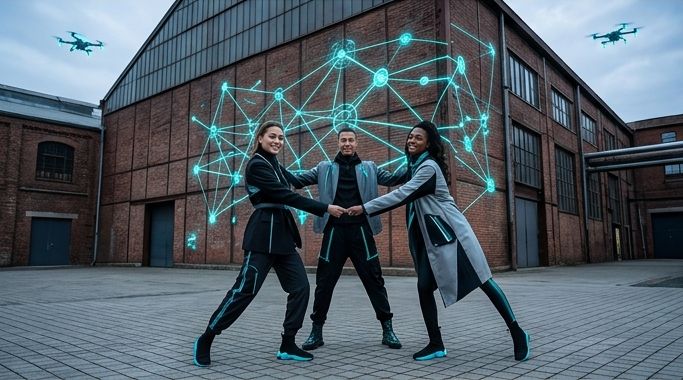
The AntiVJ collective, formed around 2007 by artists including Yannick Jacquet, Joanie Lemercier, and Romain Tardy, demonstrated that a loose community of artists sharing aesthetic sensibilities can operate as a coherent creative force without formal incorporation. Meanwhile, the Ars Electronica Festival in Linz, running since 1979, has shaped video-mapping culture by treating art, technology, and society as a single domain of inquiry, and its Prix Ars Electronica has launched careers that have shaped the discipline.
Grassroots collectives in Amsterdam, Warsaw, and São Paulo grew fast in the early 2010s, then fell apart when founding members moved on. The ones that survived had spread leadership before capacity dropped and written things down so newcomers could step in without a lengthy handover.
Future Directions
Unreal Engine’s nDisplay and generative tools being integrated into TouchDesigner are changing what’s practically achievable. Communities that start building literacy with these tools now will be in a stronger position than those waiting for things to settle. The Processing Foundation’s two decades of accessible programming education is a model worth borrowing for youth outreach. Global networks bring in new ideas; local hubs – Light Night Leeds, Eastern European collectives – are what keep a community grounded.
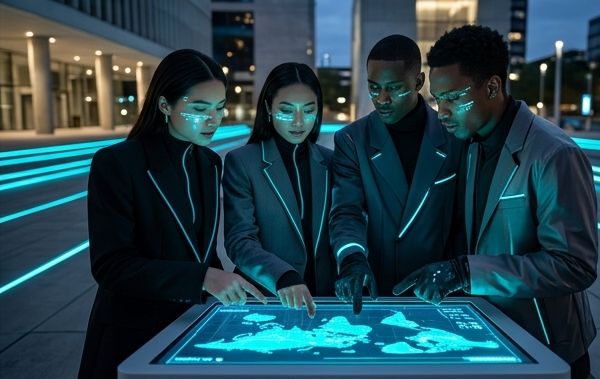
Video mapping thrives when it’s shared – openly, and with genuine curiosity about what the person across the table knows that you don’t.
The most innovative work in video mapping has come from communities, not isolated individuals. That’s not an observation – it’s an argument for showing up, contributing, and sharing what you know, including the failures.
There are events, there are ideas behind this article – but content is always the game-changer. That’s why we invite you to visit our website, where you’ll find a treasure trove of creative concepts for projection shows across formats, styles, and adaptive scenarios. Let your next event start with inspiration.