
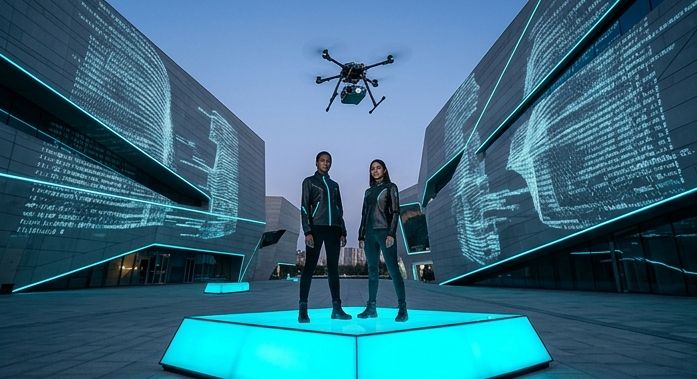
What Projection Mapping Actually Is
Projection mapping – sometimes called spatial augmented reality or video mapping – is the technique of projecting carefully calibrated digital imagery onto irregular, three-dimensional surfaces so that the light appears to belong to the object rather than merely fall upon it. A building facade becomes a living canvas. A dancer’s costume erupts in geometric patterns that track every movement. A product on a pedestal cracks open to reveal its inner architecture. The core principle is simple: align content geometry to physical geometry so precisely that the boundary between the real and the projected disappears.
What has changed dramatically in recent years is not the principle but the machinery, workflows, and creative ambitions that surround it. The global projection mapping market was valued at approximately $4.0–$5.7 billion in 2024 and is forecast to reach between $16 and $21 billion by 2032, growing at a compound annual rate of 17–23 percent (360iresearch.com). That growth trajectory reflects a technology moving from bespoke spectacle to accessible production tool.
The Traditional Approach and Its Limits
For most of projection mapping’s commercial history – roughly 2008 to 2019 – the workflow followed a predictable path. A team would survey a surface, build a 3D model of it, render video content offline, then painstakingly align each projector to the model during an on-site installation period that could last days or weeks. The content was essentially fixed: a pre-rendered film stitched to a building. If a surface changed, or a projector shifted, or the client wanted different content for the following week, the entire pipeline had to restart.
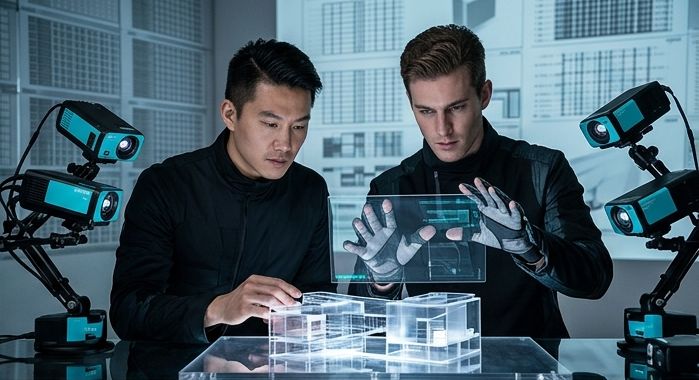
This static model produced extraordinary results – the pioneer shows on Buckingham Palace or Lyon’s cathedral are legitimately breathtaking – but it was slow, expensive, and deeply unresponsive to live context. It could not react to an audience, adapt to weather, or incorporate live data feeds. Real-time interaction was theoretical, not practical.
Real-Time Rendering and the Engine Revolution
The most consequential shift in contemporary projection mapping is the adoption of real-time rendering engines – primarily Unreal Engine and Unity – as content delivery platforms rather than just pre-visualisation tools. These engines, originally developed for video games, can generate high-resolution 3D environments at 60 or more frames per second, responding instantly to any input: sensor data, audio analysis, crowd movement, or live broadcasts.
Disguise (formerly d3), the London-based platform that has become an industry standard for large-scale productions, integrates directly with Unreal Engine and provides pixel-perfect mapping across multi-projector arrays in real time. Its OmniCal calibration system automatically corrects for projector misalignment without manual intervention, dramatically compressing installation time. Residency “Weekends with Adele” in Las Vegas, universally praised for its floor-to-ceiling immersive staging, was powered by Disguise GX3 servers running precisely this real-time pipeline (disguise.one). The content could respond to the live performance rather than merely accompany it.
In the pre-visualisation space, Disguise’s Mapping Matter – a cloud-based web tool that simulates multi-projector setups in a browser without requiring specialist software – has been used by teams at Cirque du Soleil and Moment Factory to validate complex installations remotely before a single projector is installed on site (disguise.one/mapping-matter).
AI-Driven Workflows
Artificial intelligence is accelerating every phase of the production pipeline. According to analysis by NewMedia Immersive Events, AI-driven platforms now automate UV unwrapping, texture generation, and edge-blend optimisation – tasks that previously required weeks of specialised labour – compressing total deployment times from months to weeks and enabling a new tier of mid-budget activations that were previously cost-prohibitive (newmedia.events).
Software tools are growing faster than hardware: software is the fastest-growing component of the projection mapping market, advancing at a 30.12% CAGR as subscription-based cloud models replace one-time hardware purchases. AI-powered calibration, in particular, is removing the dependency on highly specialised operators: sensor arrays and computer vision algorithms now detect surface geometry and projector position automatically, re-aligning content if hardware drifts during a multi-night run.
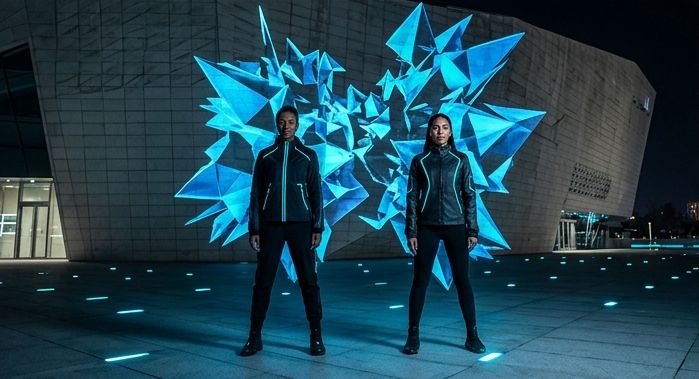
Research published in IEEE Transactions on Visualization and Computer Graphics in January 2025, from Tokyo Institute of Technology, introduced a high-speed dynamic facial projection mapping system capable of tracking facial landmarks in real time using a hybrid method combining Ensemble of Regression Trees and temporal frame-cropping – enabling content to be mapped onto a moving human face with sub-frame latency (sciencedaily.com). This opens projection mapping to performance art applications that were previously impossible.
Interactive and Sensor-Driven Installations
The third major methodological shift is interactivity: shows that respond to the audience rather than simply displaying at them. TouchDesigner by Derivative has become the go-to node-based visual programming environment for interactive installations, allowing designers to route sensor inputs – motion capture, LIDAR, microphones, even biometric data – directly into real-time content generation pipelines (map.club).
Real-time projection tracking commanded 56.2% of the global projection mapping systems market in 2025, reflecting how central audience-responsiveness has become to the medium (coherentmarketinsights.com).
Case Studies in New Practice
Tokyo Night & Light (2024–present) is the most comprehensively documented recent case study in large-scale permanent projection mapping. Since its launch on 25 February 2024, the nightly show on the Tokyo Metropolitan Government Building in Shinjuku covers 13,904 square metres of facade – certified by Guinness World Records as the largest permanent architectural projection-mapped display in history. It deploys 40 Panasonic projectors (20 PT-RQ50K units at 50,000 lumens and 20 PT-RZ34K units at 30,500 lumens), synchronised with a 22-speaker RAMSA 3D audio system. Critically, the entire installation is managed remotely via Panasonic’s AcroSign cloud platform, requiring no permanent on-site operations staff – a model of cloud-controlled spatial production that points toward the industry’s operational future (panasonic.com). Content is updated remotely and has included work ranging from Belgian CG artist Maxime Guislain’s Evolution to a Godzilla 70th-anniversary commission.
Al Wasl Dome, Expo City Dubai is the landmark case study in interactive 360-degree architectural mapping. Bild Studios, working with Disguise, transformed the 130-metre-diameter dome – the world’s most complex 360-degree projection installation – into a live interactive audiovisual experience that connected audiences inside and outside the dome simultaneously (disguise.one). The installation required synchronising dozens of projectors across a curved surface while feeding real-time generative content from Unreal Engine.
Illuminus Boston (2024) deployed Barco UDM and UDX series projectors across city blocks to deliver high-resolution architectural mapping as part of a public art festival – demonstrating that civic-scale projection mapping is now achievable outside the mega-budget bracket (databridgemarketresearch.com).
Xi’an Tree of Life (June 2025) saw Barco partner with Landsky Technology to project 4K content onto a 57-metre-tall structure using 28 projectors, weaving ancient Silk Road imagery into a contemporary light installation – a model of projection mapping as cultural diplomacy and tourism infrastructure simultaneously (globenewswire.com).
Interdisciplinary Methods: Architecture, Performance, Installation
Contemporary projection mapping has dissolved the boundaries between disciplines. Architects now treat facades as screens during the design process, specifying projection geometries alongside structural systems. Performance designers integrate real-time body-tracking so that a performer becomes both actor and triggering device for the surrounding visual environment. Museum curators use short-throw projectors to layer interpretive content onto artefacts without physical contact. Academic research published in Proceedings of the Japan Academy (2024) formally categorised projection mapping’s applications across entertainment, medicine, product design, and telecommunications – reflecting how far the technology has migrated from its origins in live events (pmc.ncbi.nlm.nih.gov).
Future Directions
Several trajectories will define the next generation of projection mapping practice. Sustainable operation is an urgent priority: Tokyo Night & Light runs on solar-generated electricity, pointing toward renewable-powered permanent installations as a new standard. Holographic integration – combining traditional projection with volumetric light-field displays – is advancing in research settings and will gradually reach commercial deployment. AR overlays, where handheld devices or wearable glasses layer additional content onto physical projection shows, will expand audience participation beyond passive spectatorship. And generative AI content pipelines, where large language models and diffusion models produce site-specific visual material in response to real-time prompts, will fundamentally alter the relationship between curator, artist, and machine.
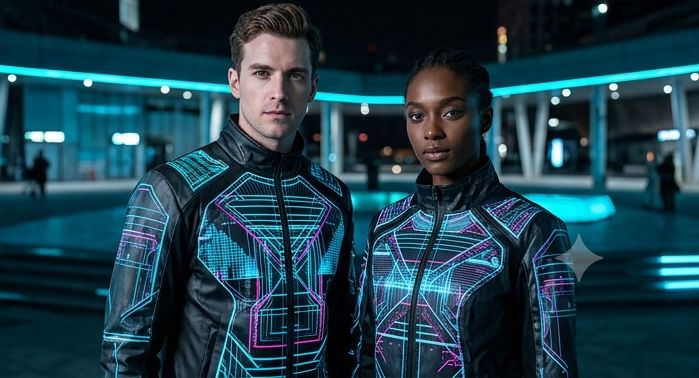
The deeper shift, however, is structural: projection mapping is moving from event to infrastructure. Tokyo Night & Light is not a festival but permanent amenity, maintained remotely, updated seasonally, integrated into the city’s tourism economy year-round. That model – affordable, cloud-managed, continuously evolving – is likely to define how cities and institutions think about projection mapping for the decade ahead.
There are events, there are ideas behind this article – but content is always the game-changer. That’s why we invite you to visit our website, where you’ll find a treasure trove of creative concepts for projection shows across formats, styles, and adaptive scenarios. Let your next event start with inspiration.