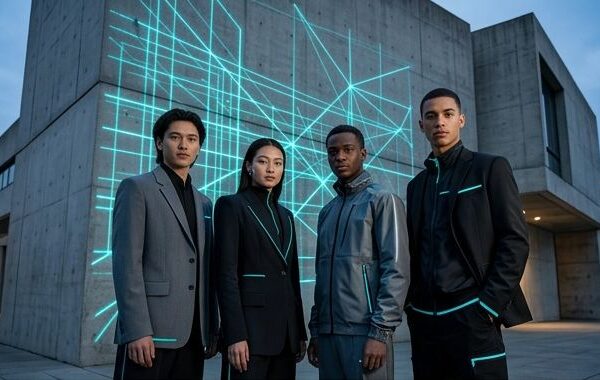

Video mapping – or projection mapping – aligns digital imagery precisely onto real-world surfaces: building facades, stage sets, sculptures, even moving objects. Unlike a flat-screen display, it transforms irregular geometry into a dynamic visual canvas, dissolving the line between physical space and digital storytelling. As productions have grown in scale, reliable infrastructure has become essential. A single modern installation can involve dozens of projectors, multiple synchronized streams, and terabytes of content managed in real time – all of which demand a dedicated server architecture purpose-built for live visual production. This article explores how video-mapping servers have become the operational backbone of complex projections, examining their evolution, core functions, technical requirements, and the innovations shaping their future.
The Evolution of Video Mapping
Projection mapping traces its roots to the late 1960s, when Disney Imagineers used early techniques to animate the busts in the Haunted Mansion attraction. Technically primitive – fixed geometry, single projectors, no real-time processing – but they established an enduring principle: projection as a tool for transforming space.
Through the 1980s and 1990s, artists explored architectural projection for site-specific performances, relying on pre-rendered video loops, tape playback, and manual physical alignment. Visually striking but technically fragile.
The shift toward server-driven systems came in the mid-2000s, when real-time rendering engines matured, and affordable high-lumen projectors proliferated. Large-scale shows became feasible for a far wider range of events, and by the 2010s, architectural mapping was a fixture of advertising, cultural festivals, and concerts. The complexity of these productions created a demand for purpose-built media servers.
Core Functions of Video Mapping Servers
Video mapping servers are high-performance media engines built for multi-output synchronized delivery.
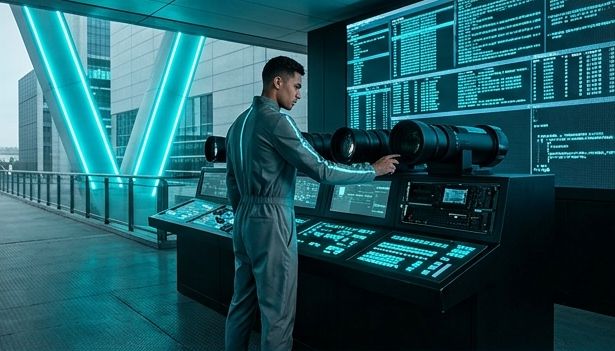
Stream processing and synchronization are the primary tasks. A server decodes and outputs multiple video streams simultaneously – often at 4K or higher – while keeping them perfectly temporally aligned. A single frame of drift between adjacent projectors creates a visible seam; hardware genlock and timecode synchronization ensure every output fires at exactly the same moment.
Multi-projector management covers routing composition regions to specific projectors, handling edge blending for seamless panoramic images, and matching gamma across units with varying hardware characteristics.
Audio and lighting integration transforms the server into a show-control node. Via MIDI, OSC, and Art-Net protocols, it exchanges cues with sound and lighting consoles – delivering the synchronized multi-sensory impact that defines large-scale live events.
Show continuity is equally vital. Watchdog processes, content failover, and redundant output paths ensure a single hardware fault does not bring production to a halt in front of thousands.
Managing Complex Visual Projections
The challenges of complex mapping grow non-linearly with scale. A two-projector wall show is a fundamentally different problem from a 360-degree architectural installation covering an entire city block.
Surface calibration is the first hurdle. Real surfaces are never perfectly flat or reflectively consistent, and they shift with temperature and time. Servers address this through warp-mesh calibration – building a precise digital model of the surface via structured light scanning or photogrammetry – onto which content is mathematically projected.
Layering and compositing add depth. Modern shows stack background animations, particle systems, typographic overlays, and live feeds on independent compositing layers with separate blend modes. The server manages this stack in real time without dropping frames.
3D objects and interactive elements push requirements further. Mapping onto three-dimensional or moving surfaces requires the server to maintain a real-time geometric model. Camera, LiDAR, or motion-tracking inputs feed into the pipeline, enabling output that responds dynamically to the physical environment.
Real-world cases illustrate the range of the challenge:
Lyon Fête des Lumières (annual, December, Lyon, France) is among the most technically demanding urban mapping events in the world. In 2023, the festival presented 32 installation sites across the city and drew 2.3 million visitors over four days. At the Place des Terreaux alone – the festival’s historic centerpiece – Groupe Novelty deployed a multi-projector rig to cover the baroque facade of the City Hall and the Bartholdi fountain simultaneously, with content synchronized across projectors running live through dedicated media servers. The 2023 edition saw 920,000 visitors at that single site. (Official festival site)
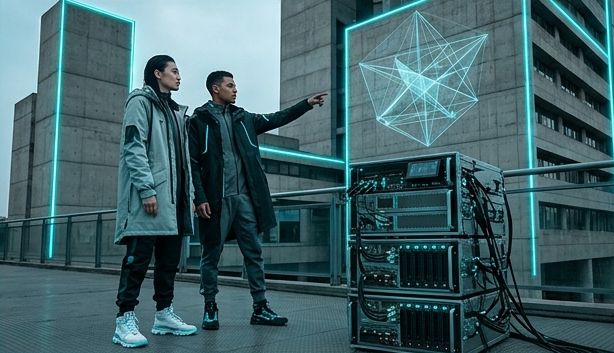
Moment Factory – Ode à la Vie: Sagrada Família, Barcelona (2012) was the first sound and light projection ever staged on Antoni Gaudí’s unfinished basilica. Commissioned by the cities of Barcelona and Montréal for the La Mercè Festival, the 15-minute show used 16 video projectors, 13 computers, and 25 moving lights to map a 150 m × 30 m canvas across the Nativity façade (the oldest and only fully completed exterior of the church). The entire show ran live through Moment Factory’s proprietary X-Agora playback system, with content responding to the deeply irregular carved surfaces in real time. Over 32,000 people attended. (Moment Factory project page)
teamLab Borderless (opened in its current form at Azabudai Hills, Tokyo, February 2024) uses supercomputers and, in past iterations, up to 140 Epson projectors to create a museum in which artworks have no fixed location – flowing between rooms, reacting to visitors’ movements in real time, and continuously altering each other’s state. The installation relies on server infrastructure capable of calculating the real-time physics of millions of simulated particles while maintaining consistent output across every surface simultaneously. The museum welcomed 1.69 million visitors in 2025 and was named by TIME magazine as one of the World’s Greatest Places 2024. (Official teamLab Borderless page)
Hardware and Software Considerations
Professional servers demand serious hardware. GPU performance is the primary constraint: rendering, warping, blending, and outputting multiple high-resolution streams requires workstation-class graphics, often in multi-GPU configurations where each card handles a cluster of outputs.
Storage throughput is equally critical. Uncompressed 4K video at 60fps consumes hundreds of megabytes per second; NVMe RAID arrays ensure content streams faster than it needs to display.
Three software platforms dominate professional practice. Resolume Arena (resolume.com) handles live performance and medium-scale mapping with an intuitive compositing interface; it is used for projects ranging from club VJ sets to LED mappings on main stages at festivals like Ultra. TouchDesigner (derivative.ca) provides a node-based procedural environment ideal for interactive and generative work — the backbone of many sensor-driven installations. MadMapper (madmapper.com) specializes in architectural and object mapping with a workflow optimized for fast on-site calibration.
A real-world example of software in production: for Carlos Vives’ Después De Todo 2023 tour, VJ Melissa Gordillo built the entire visual pipeline around Resolume Arena, combined with a network of eight NDI-enabled cameras and a Netgear M4250 switching infrastructure – demonstrating how IP-based protocols now underpin touring-scale video production. (BirdDog case study)
Redundancy is non-negotiable in live contexts. Deployments always include a hot-standby server ready to take over instantly on primary failure. Protocols such as NDI and SMPTE 2110 enable high-bandwidth IP-based video transport, supporting distributed architectures across large venues.
Workflow and Best Practices
A successful show is built long before the first projector powers on. Content creation begins with a surface survey that defines the digital canvas geometry. Artists design materials that account for perspective, surface texture, and projector characteristics.
Pre-production testing validates configurations against mockups, catching calibration issues before the live event. Moment Factory has published extensively on this challenge for architectural-scale work: spatial drift and seam issues typically only reveal themselves at full projection scale, making early virtual simulation critical. For its recent 18K-resolution generative content pipeline, the studio used ComfyUI to compress days of iteration into hours while preserving spatial precision. (Moment Factory / ComfyUI case study)
On-site calibration refines the digital model against the actual surface. Blending, warping, and brightness matching can take hours and demand both precise tooling and an experienced operator’s eye.
During the show, operators monitor outputs, content timing, and cues in real time, ready to act if a projector drops or a layer drifts.
Post-show analysis turns performance logs and operator notes into improvements for every future deployment.
Future Trends in Video Mapping Servers
AI-assisted calibration is among the most impactful near-term advances. Machine learning models can automate the warp-and-blend process, which currently requires hours of skilled labor, reducing setup time and improving consistency. Moment Factory’s generative AI pipeline for architectural-scale content is an early production example of this shift.
Cloud-based management is becoming practical as bandwidth grows. Platforms can host content libraries and offload rendering, enabling learner field servers supported by remote compute infrastructure.
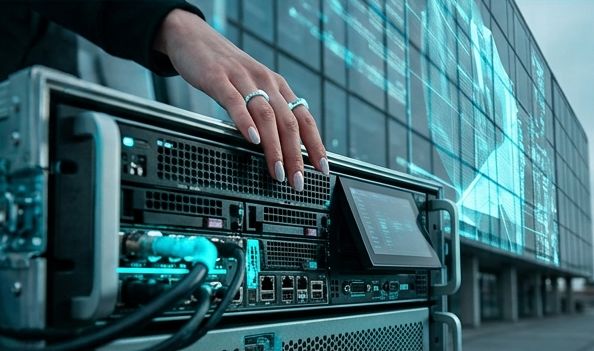
Audience-interactive installations – where viewer movement or mobile input shapes the projection in real time – are driving demand for tighter sensor integration and lower-latency pipelines. teamLab’s “Digitized City” series, in which visitors use smartphones to interact with building facades in real time, is a sustained example of this direction. (teamLab interactive projection concept)
AR and VR convergence is the most transformative horizon. As physical projection and head-mounted display content begin coexisting in unified mixed-reality experiences, mapping servers will need to serve both physical projectors and virtual rendering engines from a single architecture.
Video mapping servers are the operational heart of modern visual productions – synchronizing projectors, managing layered content, integrating with sound and light, and maintaining continuity through every performance. From intimate installations to city-scale architectural spectacles like the Lyon Festival of Lights or teamLab Borderless, they translate creative ambition into reliable reality.
As AI, cloud infrastructure, and immersive technology continue to evolve, server capabilities will grow in step – enabling experiences that are more interactive, more ambitious, and more deeply woven into the spaces they inhabit. The physical surface is no longer a boundary. It is a beginning.
There are events, there are ideas behind this article – but content is always the game-changer. That’s why we invite you to visit our website, where you’ll find a treasure trove of creative concepts for projection shows across formats, styles, and adaptive scenarios. Let your next event start with inspiration.